Mechanical Operations
GATE CH Guide
Particle characterization, size reduction, screening, settling, filtration, fluidization, and agitation for the GATE Chemical Engineering paper.
Overview
Mechanical Operations covers how solids are handled, sized, separated, and moved through a chemical plant, the physical (rather than chemical or thermal) unit operations. In the GATE CH syllabus it groups particle technology (characterization, size reduction, screening), particle-fluid separations (settling, filtration, fluidization), and mixing/conveying into one section that's distinct from, but frequently paired with, Fluid Mechanics numericals.
The section has a natural progression: first you characterize particles (size, shape, size distribution), then you change their size (crushing, grinding) or separate them by size (screening) or classify them by settling behavior. From there, particle-fluid systems dominate, sedimentation and settling velocity (Stokes' law and its corrections), filtration (constant-pressure and constant-rate operation, cake resistance), and fluidization (minimum fluidization velocity, a direct extension of the Ergun equation from Fluid Mechanics). Agitation and mixing round out the syllabus as a lower-frequency but still-tested subtopic.
Many of these numericals reduce to a force balance, gravity, buoyancy, and drag for a settling particle; pressure drop and area for a filter cake, so the algebra is usually simpler than it looks once the governing balance is identified. Since fluidization and packed-bed flow both extend the Ergun equation directly, working through this site's Fluid Mechanics guide alongside this one reinforces the same force-balance logic from two angles.
Real GATE CH PYQ Frequency (2024–2026)
| 2024 | 2025 | 2026 | 3-Yr Avg |
|---|---|---|---|
| 3 | 4 | 4 | 3.7 |
Computed directly from 11 real questions tagged to this topic across our GATE CH 2024–2026 archive, averaging 3.7 questions/year. Browse the underlying 11 questions for this topic in the PYQ archive, or see the full topic weightage comparison across all topics.
GATE Weightage
Mechanical Operations typically contributes 3–5 questions (about 5–9 marks) to the GATE CH paper, spread across particle characterization/size reduction, settling/filtration, and fluidization.
| Sub-area | Approx. Marks |
|---|---|
| Settling & sedimentation (Stokes' law) | ~1–2 |
| Filtration (constant-pressure/rate) | ~1–2 |
| Size reduction & screening | ~1–2 |
| Fluidization & agitation | ~1–2 |
Sub-area split is a directional estimate (our archive doesn't tag marks at this granularity), for the real, computed topic-level total, see "Real GATE CH PYQ Frequency" above.
Key Subtopics
Particle characterization
Sphericity, mean particle diameter (arithmetic, surface, volume, Sauter mean), and particle size distributions from sieve analysis.
Size reduction
Crushing and grinding laws, Rittinger's, Kick's, and Bond's laws, relating energy input to the size reduction achieved, plus mill types (jaw crusher, ball mill).
Screening
Screen effectiveness for oversize and undersize fractions, based on a mass balance across a screen given feed, overflow, and underflow compositions.
Sedimentation & settling
Stokes' law for the terminal settling velocity of a single particle in the creeping-flow regime, with corrections (Reynolds-number-dependent drag coefficient) outside that regime.
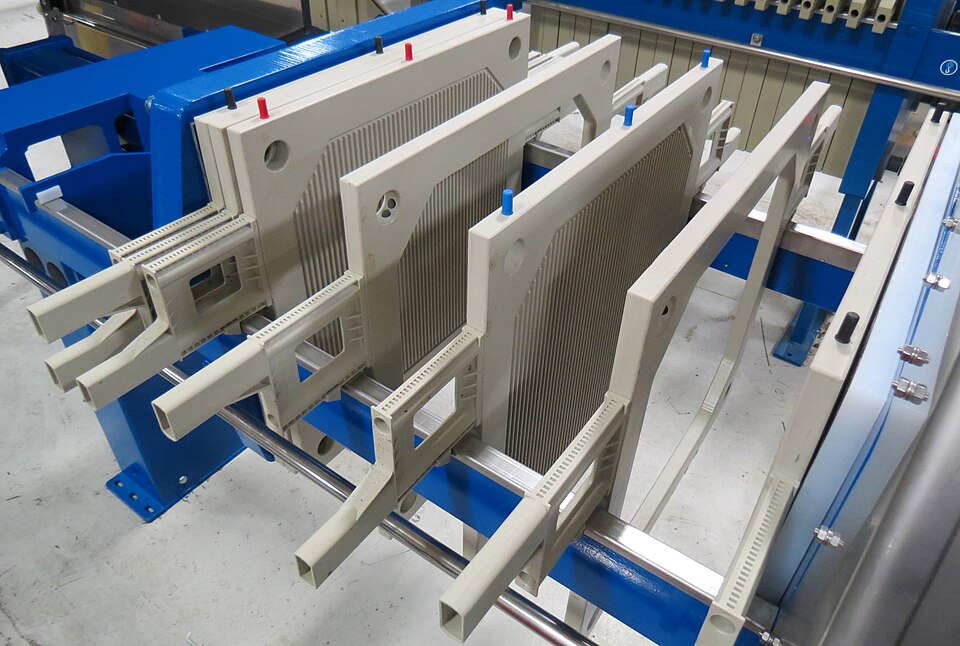
Filtration
Cake filtration theory, specific cake resistance, constant-pressure vs. constant-rate filtration, and the effect of cake compressibility on filtration rate.
Fluidization
Minimum fluidization velocity (from equating Ergun-equation pressure drop to bed weight per unit area) and the distinction between particulate and aggregative (bubbling) fluidization.
Agitation & mixing
Power number and Reynolds number correlations for stirred-tank agitators, and criteria for selecting impeller type and mixing time.
Conveying & storage
Belt and screw conveyor basics, and considerations for bulk solid storage (angle of repose, flow patterns in hoppers).
Essential Formulas
Full formula reference →Sphericity, a shape factor equal to 1 for a perfect sphere
Stokes' law terminal settling velocity (valid for particle Reynolds number < 1)
Particle Reynolds number, checks whether Stokes' law (creeping flow) applies
Cake filtration rate equation (α = specific cake resistance, c = mass solids/volume filtrate, Rm = medium resistance)
Linearized constant-pressure filtration equation, plot t/V vs. V to extract α and Rm
General size-reduction energy law; n = 2 (Rittinger), n = 1 (Kick), n = 1.5 (Bond)
Bond's law for grinding work, using the work index Wi
Minimum fluidization velocity, found by equating Ergun-equation pressure drop to the bed's net weight per unit area
Power number for a stirred-tank agitator (P = power, N = impeller speed, D = impeller diameter)
Overall screen effectiveness combining oversize and undersize recovery
Visual Reference
Derivations & Physical Insight
Deriving Stokes' Law from a Force Balance on a Settling Sphere
A particle settling through a fluid experiences three forces: gravity pulling it down, buoyancy pushing it up, and drag resisting its motion. At terminal velocity, acceleration is zero, so these three forces balance exactly:
For creeping flow (particle Reynolds number < 1), the drag force on a sphere is given exactly by Stokes' analytical solution to the Navier-Stokes equations, F_D = 3πμd_pv_t. Substituting this into the force balance and solving for v_t gives the familiar Stokes'-law terminal velocity, valid only in that creeping-flow regime, which is why every settling problem should start by checking the resulting Reynolds number.
Why Constant-Pressure Filtration Rate Slows Over Time
As filtration proceeds under constant applied pressure difference, the cake of accumulated solids on the filter medium keeps growing thicker, adding more resistance to flow, but the driving force (ΔP) stays fixed. Since the flow rate through the cake and medium is proportional to ΔP divided by the total resistance (cake resistance + medium resistance), and the cake resistance grows in proportion to the volume of filtrate already collected, the instantaneous filtration rate dV/dt must decrease continuously even though ΔP never changes.
Integrating the rate equation over time (with ΔP held constant) produces a relationship where t/V is linear in V, this is exactly why lab filtration data is analyzed by plotting t/V against V: the slope gives the specific cake resistance α and the intercept gives the medium resistance R_m, both needed to scale up a filtration numerical from lab data to a full-size filter.
Worked Practice Problems
Original practice problems in the GATE CH style, not copied from any question bank. Work them before reading the solution.
Terminal Settling Velocity Check via Stokes' Law
Problem: A spherical particle (dp = 50 μm, ρp = 2600 kg/m³) settles in water (ρf = 1000 kg/m³, μ = 0.001 Pa·s). Find the terminal settling velocity and confirm Stokes' law applies.
Given: dp = 50×10⁻⁶ m, ρp = 2600 kg/m³, ρf = 1000 kg/m³, μ = 0.001 Pa·s, g = 9.81 m/s².
Answer: v_t ≈ 2.18×10⁻³ m/s (2.18 mm/s); Re_p ≈ 0.11, well within the Stokes' law regime.
Minimum Fluidization Velocity, Simplified Laminar Case
Problem: A bed of particles (dp = 200 μm, ρp = 2500 kg/m³) is fluidized by air (ρf = 1.2 kg/m³, μ = 1.8×10⁻⁵ Pa·s) with voidage at minimum fluidization εmf = 0.45. Estimate vmf using the laminar (viscous-term-only) form of the Ergun equation.
Given: dp = 2×10⁻⁴ m, ρp = 2500 kg/m³, ρf = 1.2 kg/m³, μ = 1.8×10⁻⁵ Pa·s, εmf = 0.45, g = 9.81 m/s².
Answer: vmf ≈ 0.030 m/s (3.0 cm/s).
Topic-wise PYQ Frequency
Filtration
Tested regularly, GATE 2025 Q49 and GATE 2026 Q49 both drew numericals from cake filtration theory.
Drying (shared with Drying & Humidification guide)
GATE 2024 Q43 and GATE 2025 Q65 tested drying, see the dedicated Drying & Humidification guide for depth.
Settling & particle characterization
GATE 2024 Q58 (settling) and GATE 2025 Q41 (particle characterization) both appeared in recent papers.
Screening & size reduction
GATE 2026 Q30 (screen sizes) and Q45 (comminution) confirm this is tested regularly, usually as a shorter numerical.
Conveying & bulk handling
GATE 2026 Q11 tested conveyors, a less frequent but recurring conceptual topic.
Fluidization
Tested less often as a standalone numerical than in Fluid Mechanics packed-bed problems, but minimum fluidization velocity does appear periodically.
Recommended Study Order
- 1
1. Particle characterization
Sphericity and mean-diameter definitions are used as inputs to every later numerical in this section.
- 2
2. Settling & sedimentation
Stokes' law is a quick, high-yield force-balance calculation, practice checking the Reynolds number regime alongside it.
- 3
3. Filtration
A recurring numerical style, practice the constant-pressure linearized equation until the α/Rm extraction is automatic.
- 4
4. Screening & size reduction
Mass-balance-driven screen effectiveness and the three grinding laws are quick to learn once material-balance habits (from Process Calculations) are solid.
- 5
5. Fluidization
A direct extension of the Ergun equation from Fluid Mechanics, study once that section is comfortable.
- 6
6. Agitation, mixing & conveying
Lowest PYQ frequency, a light conceptual pass covering power number and conveyor basics is usually sufficient.
Common Pitfalls
✗ Applying Stokes' law without checking the particle Reynolds number.
✓ Stokes' law only holds for Re_p < 1; for larger particles or higher velocities, use a Reynolds-number-dependent drag coefficient correlation instead.
✗ Confusing specific cake resistance (a cake property) with medium resistance (a filter-cloth property) when reading a t/V vs. V filtration plot.
✓ The slope of t/V vs. V gives α (cake resistance); the y-intercept gives Rm (medium resistance), don't swap which one comes from which.
✗ Using superficial velocity and interstitial velocity interchangeably in fluidization or packed-bed calculations.
✓ The Ergun equation (and minimum fluidization velocity) uses superficial velocity, based on the empty-bed cross-section, divide by voidage ε to get the actual interstitial velocity if needed.
✗ Picking the wrong size-reduction law (Rittinger's vs. Kick's vs. Bond's) for the given particle size range.
✓ Rittinger's law fits fine grinding (new surface area dominates), Kick's law fits coarse crushing (volume reduction dominates), and Bond's law is the general-purpose industrial default, check which one a problem specifies before applying it.
Put It Into Practice
Work the settling-velocity and fluidization problems above with a Reynolds-number check at each step, then apply the same force-balance approach across the Mechanical Operations questions in the full GATE previous-year test set.
Keep Exploring
Related
Fluid Mechanics
Full syllabus breakdown for Fluid Mechanics, subtopics, essential formulas, PYQ frequency, and recommended study order.
Open →Heat Transfer
Full syllabus breakdown for Heat Transfer, subtopics, essential formulas, PYQ frequency, and recommended study order.
Open →Reynolds Number
Determine flow regime (laminar / transitional / turbulent) from fluid properties and pipe geometry.
Open →GATE CH Formula Sheet
Every core GATE Chemical Engineering formula in one place, grouped by topic with variable definitions.
Open →GATE Practice Tests by Year
Full-length, timed GATE CH practice tests (2024–2026) with instant, step-by-step-explained results.
Open →