Absorption, Stripping
& Extraction Guide
HTU-NTU, operating lines, minimum liquid-to-gas ratio, and liquid-liquid extraction for the GATE Chemical Engineering paper.
Overview
Absorption, stripping, and liquid-liquid extraction are the "sister" separations to distillation within the Mass Transfer section, instead of separating by relative volatility, they separate by transferring a solute between two immiscible (or partially miscible) phases: gas and liquid for absorption/stripping, and two liquids for extraction. Where distillation needs a volatility difference, these operations need a solubility or distribution-coefficient difference, which makes them useful exactly where distillation isn't, recovering a dilute solute from a gas stream, or separating close-boiling liquids that distillation handles poorly.
Gas absorption (a solute transfers from gas into liquid, e.g. scrubbing CO2 or H2S from a gas stream) and stripping (the reverse, solute transfers from liquid into gas) share the same mathematical structure: an operating line from an overall mass balance around the packed tower, an equilibrium curve or Henry's law line, and either graphical stage-counting (like McCabe-Thiele) or the HTU-NTU (height/number of transfer units) approach for continuous-contact packed columns. Liquid-liquid extraction runs the same logic with a distribution coefficient (analogous to Henry's constant) governing how solute splits between the two liquid phases, often visualized on a triangular phase diagram for partially miscible ternary systems.
The unifying thread across this guide is minimum liquid-to-gas (or solvent-to-feed) ratio, the point where the operating line touches the equilibrium curve, exactly analogous to minimum reflux in distillation. Once that connection clicks, absorption/stripping/extraction numericals become a matter of recognizing which variant of the same graphical logic a problem is asking for.
Real GATE CH PYQ Frequency (2024–2026)
No questions in our 2024–2026 archive were tagged to this specific subtopic on its own, they're grouped under the broader Mass Transfer category. See the full topic weightage table for the real, computed numbers.
GATE Weightage
Absorption, stripping & liquid-liquid extraction typically contribute 2–3 questions (about 3–5 marks) within the Mass Transfer section of the GATE CH paper, with absorption tested more frequently than extraction.
| Sub-area | Approx. Marks |
|---|---|
| Gas absorption (HTU-NTU, operating line) | ~1–2 |
| Stripping & minimum liquid-to-gas ratio | ~0–1 |
| Liquid-liquid extraction & distribution coefficient | ~1 |
Sub-area split is a directional estimate (our archive doesn't tag marks at this granularity), for the real, computed topic-level total, see "Real GATE CH PYQ Frequency" above.
Key Subtopics
Gas absorption fundamentals
A solute transfers from a gas phase into a liquid solvent in a packed or tray tower, governed by Henry's law (or a curved equilibrium relationship) at dilute concentrations.
Operating line for absorption
A straight line from an overall solute mass balance around the tower (or any section of it), analogous to the McCabe-Thiele operating line but for gas-liquid contact instead of vapor-liquid equilibrium stages.
Minimum liquid-to-gas ratio
The L/G ratio at which the operating line touches the equilibrium curve (a pinch point), using less liquid than this makes the required column infinitely tall, exactly analogous to minimum reflux in distillation.
HTU-NTU method
Height of a transfer unit (HTU, a mass-transfer-coefficient property of the packing) times the number of transfer units (NTU, a driving-force integral) gives the total packed height, the standard continuous-contact design method.
Stripping
The reverse of absorption, solute transfers from liquid into gas, using the same operating-line and equilibrium-curve logic with the roles of the two phases reversed.
Liquid-liquid extraction fundamentals
Solute transfers from a feed liquid into an immiscible (or partially miscible) solvent liquid, governed by a distribution coefficient m = y_solute,solvent / x_solute,feed.
Single-stage & multistage extraction
Mass-balance-driven calculations for single equilibrium-stage extraction, extended to countercurrent multistage cascades for higher recovery.
Ternary phase diagrams
Triangular diagrams representing partially miscible three-component (feed solvent, carrier, extracting solvent) systems, used to read tie-lines and the plait point.
Essential Formulas
Full formula reference →Henry's law, equilibrium partial pressure of dilute solute A, H = Henry's constant
Absorption operating line from an overall mass balance (L = liquid, G = gas molar flow rate)
Minimum liquid-to-gas ratio, analogous to minimum reflux in distillation
Packed column height from the height and number of transfer units
Number of transfer units, a driving-force integral over the tower
Height of a transfer unit, using the overall gas-phase mass transfer coefficient Ky and packing interfacial area a
Distribution (partition) coefficient for liquid-liquid extraction, analogous to Henry's constant
Extraction factor, analogous to the absorption/stripping factor, governs recovery in a multistage cascade
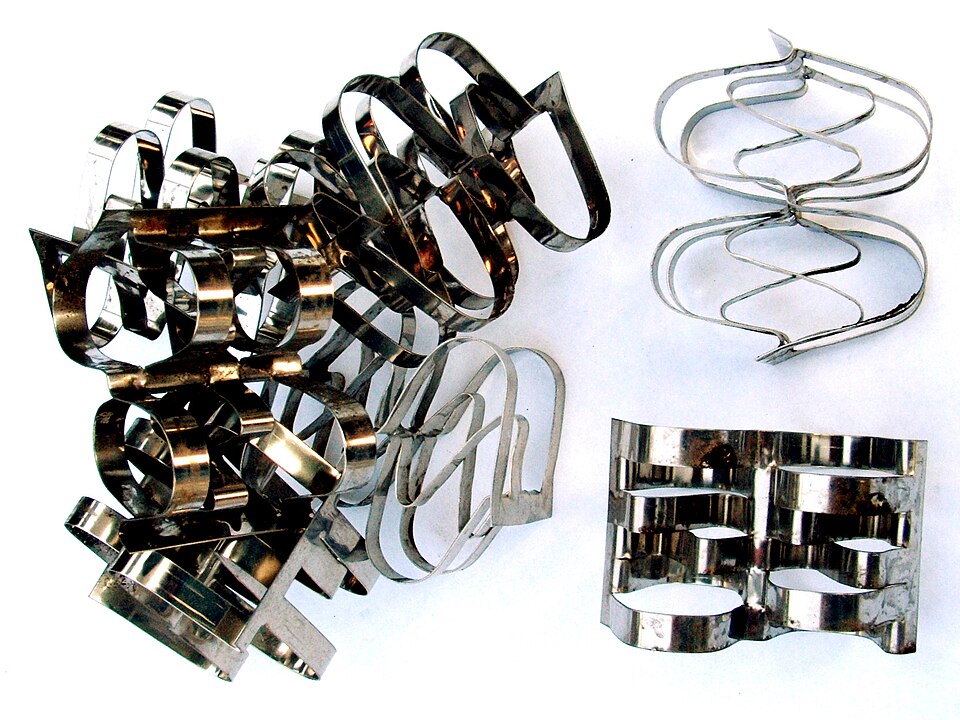
Visual Reference
Derivations & Physical Insight
Deriving the Absorption Operating Line from an Overall Balance
Consider a countercurrent packed absorption tower: gas enters at the bottom (flow G, composition y1) and leaves at the top (y2, the cleaned gas); liquid enters at the top (flow L, composition x2, typically pure or lean solvent) and leaves at the bottom (x1, the enriched solvent). A steady-state solute balance around any horizontal cross-section of the tower, from the top down to that section, must balance solute in the gas entering that section against solute leaving in both streams above it.
Because the total gas and liquid flow rates (G and L) are assumed constant along dilute-system absorption towers (only a small amount of solute transfers, so total flows barely change), this balance rearranges into a straight line relating the local gas and liquid compositions at any point in the tower, the operating line, with slope L/G:
Why the Extraction Factor Plays the Same Role as the Absorption Factor
In a multistage countercurrent absorption cascade, the absorption factor A = L/(mG) determines how effectively solute is stripped out of the gas as it rises through successive stages, a larger A means each stage removes a larger fraction of the remaining solute, so fewer stages are needed for a target recovery. Liquid-liquid extraction is mathematically identical if you relabel "gas phase" as "raffinate phase" and "liquid phase" as "extract (solvent) phase," with the distribution coefficient m playing the same role as Henry's constant.
This is why the extraction factor E = mVsolvent/Lfeed appears in extraction stage-counting formulas in exactly the same mathematical position as the absorption factor, both quantify how much "leverage" the second phase has per stage at removing solute from the first phase, and both let you reuse the same Kremser-type analytical formulas (originally derived for absorption) directly for multistage extraction problems just by swapping which physical quantities the symbols represent.
Worked Practice Problems
Original practice problems in the GATE CH style, not copied from any question bank. Work them before reading the solution.
Henry's Law Partial Pressure Calculation
Problem: A gas mixture is in equilibrium with a liquid containing a dilute solute at mole fraction x = 0.008. Henry's constant for the solute in this solvent is H = 850 kPa. Find the equilibrium partial pressure of the solute in the gas phase.
Given: x = 0.008, H = 850 kPa.
Answer: pA = 6.8 kPa
Minimum Liquid-to-Gas Ratio for a Dilute Absorber
Problem: A gas stream (y1 = 0.02) is to be scrubbed down to y2 = 0.001 using a solvent entering solute-free (x2 = 0). The equilibrium relationship is y* = 2x (dilute, linear). Find the minimum liquid-to-gas ratio (L/G)min.
Given: y1 = 0.02, y2 = 0.001, x2 = 0, equilibrium y* = 2x.
Answer: (L/G)min = 1.9 (the actual design L/G is typically set 1.2–1.5× this minimum).
Topic-wise PYQ Frequency
Absorption (operating line, HTU-NTU)
GATE 2024 Q24/Q40 and GATE 2025 Q55/Q61 (packing flooding curves) show absorption is tested regularly.
Interfacial compositions & two-film theory
GATE 2025 Q56 tested interfacial compositions directly, closely tied to the two-film theory in the parent Mass Transfer guide.
Liquid-liquid extraction
Tested less frequently as a standalone numerical than absorption, though distribution-coefficient concepts recur across mass-transfer questions generally.
Recommended Study Order
- 1
1. Henry's law & absorption fundamentals
The prerequisite equilibrium relationship for every calculation in this guide.
- 2
2. Absorption operating line & minimum L/G
The highest-yield subtopic, practice the same pinch-point reasoning used for minimum reflux in distillation.
- 3
3. HTU-NTU method
The standard packed-column sizing approach, building directly on the operating-line and equilibrium-curve concepts above.
- 4
4. Stripping
A quick extension once absorption is solid, the same equations with the phase roles reversed.
- 5
5. Liquid-liquid extraction & distribution coefficients
Lower frequency, study once absorption is comfortable, since the mathematical structure (operating line, minimum solvent ratio) directly transfers over.
Common Pitfalls
✗ Using Henry's law outside the dilute-solution range it's valid for.
✓ Henry's law assumes a linear equilibrium relationship, which only holds at low solute concentration, for concentrated systems, use the actual (often curved) equilibrium data instead.
✗ Confusing which stream (gas or liquid) an absorption operating line's slope L/G refers to versus a stripping operating line.
✓ In absorption, the operating line lies above the equilibrium curve (solute moves gas→liquid); in stripping, it lies below (solute moves liquid→gas), sketch the direction of solute transfer before setting up the balance.
✗ Forgetting that minimum liquid-to-gas ratio is a pinch-point condition, just like minimum reflux in distillation.
✓ At (L/G)min, the exiting liquid composition is in equilibrium with the entering (richest) gas, set up that equilibrium relationship first before solving for the ratio.
✗ Treating the distribution coefficient in extraction as constant across a wide concentration range without checking the phase diagram.
✓ For partially miscible ternary systems, the distribution coefficient can vary significantly with concentration, check whether the problem implies dilute (constant m) or concentrated (phase-diagram-based) conditions.
Put It Into Practice
Work the Henry's-law and minimum-L/G problems above using the same pinch-point logic as minimum reflux in distillation, then apply it to the Absorption and Extraction questions in the full GATE previous-year test set.
Keep Exploring
Related
Mass Transfer
Full syllabus breakdown for Mass Transfer, subtopics, essential formulas, PYQ frequency, and recommended study order.
Open →Distillation
Flash distillation, McCabe-Thiele, reflux ratio, and reboiler duty for GATE CH.
Open →Antoine Equation
Calculate P* = 10^(A − B/(C+T)) for Benzene and Water. Includes GATE 2025 Q47 dew point solution.
Open →GATE CH Formula Sheet
Every core GATE Chemical Engineering formula in one place, grouped by topic with variable definitions.
Open →GATE Practice Tests by Year
Full-length, timed GATE CH practice tests (2024–2026) with instant, step-by-step-explained results.
Open →