Chemical Technology
GATE CH Guide
Chlor-alkali, fertilizers, cement, petroleum refining, petrochemicals, and polymers for the GATE Chemical Engineering paper.
Overview
Chemical Technology is the one section of the GATE CH syllabus that's pure factual recall about real industrial processes rather than derived-from-first-principles calculation, it asks whether you know how ammonia, sulfuric acid, cement, or polyethylene are actually manufactured at scale, including the specific reactors, catalysts, and operating conditions each process uses. Because there's no equation to derive an answer from, it rewards structured memorization of process flow, not problem-solving speed.
The syllabus groups into two clusters. Inorganic chemical technology covers chlor-alkali (electrolytic production of chlorine, caustic soda, and hydrogen), fertilizers (ammonia via Haber-Bosch, urea, and phosphate fertilizers), and cement (the rotary kiln clinkering process). Organic/petroleum chemical technology covers petroleum refining (distillation, cracking, reforming) and petrochemicals/polymers (ethylene/propylene as building blocks, and polymerization routes to polyethylene, PVC, and similar commodity plastics).
The efficient way to study this section is to build a "process tree" for each major product: raw materials in, the key reactor/unit operation and its operating conditions, and the main product plus byproducts out. GATE questions here are almost always conceptual, matching a catalyst to a process, identifying a byproduct, or naming the operating pressure/temperature range, so a clean mental flowchart per process beats memorizing isolated facts.
Real GATE CH PYQ Frequency (2024–2026)
| 2024 | 2025 | 2026 | 3-Yr Avg |
|---|---|---|---|
| 3 | 3 | 3 | 3 |
Computed directly from 9 real questions tagged to this topic across our GATE CH 2024–2026 archive, averaging 3 questions/year. Browse the underlying 9 questions for this topic in the PYQ archive, or see the full topic weightage comparison across all topics.
GATE Weightage
Chemical Technology typically contributes 2–4 questions (about 3–6 marks) to the GATE CH paper, split roughly evenly between inorganic (fertilizers, chlor-alkali, cement) and organic/petroleum (refining, petrochemicals, polymers) processes.
| Sub-area | Approx. Marks |
|---|---|
| Fertilizers & inorganic chemicals (ammonia, urea, chlor-alkali) | ~1–2 |
| Cement & other inorganic technology | ~0–1 |
| Petroleum refining & petrochemicals | ~1–2 |
| Polymers & pulp/paper | ~1 |
Sub-area split is a directional estimate (our archive doesn't tag marks at this granularity), for the real, computed topic-level total, see "Real GATE CH PYQ Frequency" above.
Key Subtopics
Ammonia synthesis (Haber-Bosch)
N2 + 3H2 ⇌ 2NH3 over an iron catalyst at high pressure (150–300 bar) and moderate temperature (400–500°C), with unconverted gas recycled, a direct real-world example of the recycle systems covered in Process Calculations.
Urea & other fertilizers
Urea synthesis from ammonia and CO2 via ammonium carbamate as an intermediate, plus superphosphate and other phosphate-fertilizer routes from phosphate rock.
Chlor-alkali process
Electrolysis of brine (NaCl solution) to produce chlorine gas, caustic soda (NaOH), and hydrogen, via membrane cell, diaphragm cell, or the older mercury cell technology.
Sulfuric acid (Contact process)
Catalytic oxidation of SO2 to SO3 over a vanadium pentoxide (V2O5) catalyst, followed by absorption in concentrated sulfuric acid (not water directly, to avoid an uncontrollable acid mist).
Cement manufacture
Clinkering of limestone and clay in a rotary kiln at ~1450°C to form calcium silicates, followed by grinding with gypsum to control setting time.
Petroleum refining
Atmospheric and vacuum distillation to separate crude oil into fractions, followed by conversion processes (catalytic cracking, reforming, hydrocracking) that upgrade heavier fractions into higher-value, lighter products.
Petrochemicals
Steam cracking of naphtha or ethane to produce ethylene and propylene, the base building blocks for most commodity plastics and synthetic fibers.
Polymers & pulp/paper
Polymerization routes (addition polymerization for polyethylene/PVC, condensation for nylon/polyester) and the kraft (sulfate) process for pulping wood into paper.
Essential Formulas
Full formula reference →Haber-Bosch ammonia synthesis, exothermic, so high pressure (not high temperature) favors conversion by Le Chatelier's principle
Chlor-alkali electrolysis, the overall reaction across the membrane/diaphragm cell
Contact process, SO3 is absorbed into concentrated acid (forming oleum) then diluted, not absorbed directly into water
Cement clinkering reaction in the rotary kiln
Urea synthesis via the ammonium carbamate intermediate
Addition polymerization of ethylene to polyethylene
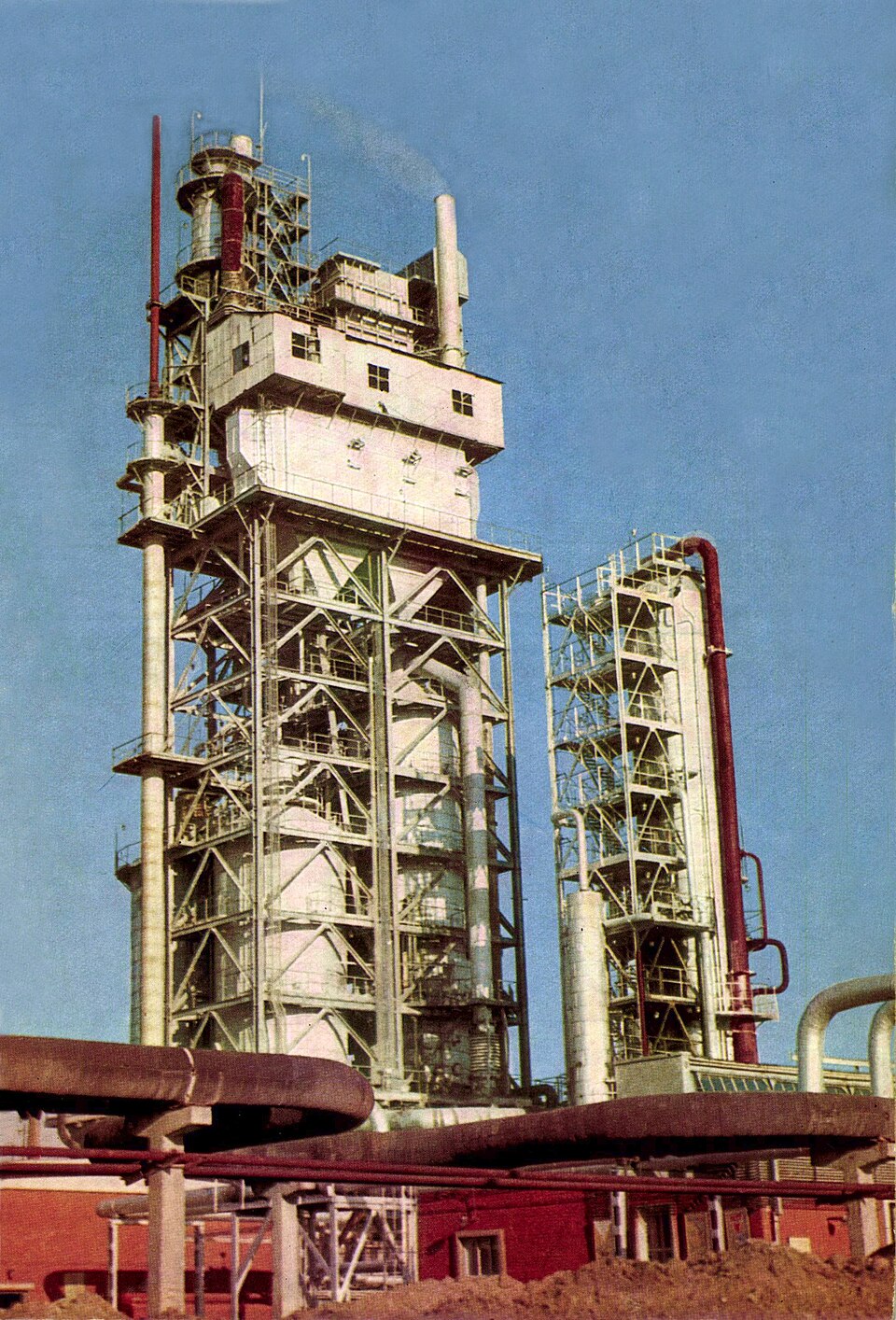
Visual Reference
Derivations & Physical Insight
Why Ammonia Synthesis Runs at High Pressure, Not High Temperature
The Haber-Bosch reaction N2 + 3H2 ⇌ 2NH3 is exothermic and reduces the total number of gas moles (4 moles of reactant gas become 2 moles of product gas). By Le Chatelier's principle, increasing pressure shifts the equilibrium toward the side with fewer moles, the product side, so higher pressure directly favors more ammonia at equilibrium. This is why industrial ammonia plants run at very high pressure (150–300 bar) despite the substantial compression cost, and it's the single biggest lever available for pushing conversion.
Temperature works against this reaction thermodynamically (being exothermic, equilibrium conversion falls as temperature rises), but the reaction is also kinetically very slow at low temperature even with a catalyst. The 400–500°C operating range is therefore a kinetic compromise, not a thermodynamic optimum, it's hot enough for the iron catalyst to give a workable reaction rate, while pressure (not temperature) is what's pushed hard to compensate for the equilibrium penalty of operating above room temperature. Any unconverted N2/H2 is separated and recycled back to the reactor, exactly the kind of recycle-loop math covered in the Process Calculations guide.
Why SO3 Is Absorbed in Concentrated Acid, Not Water, in the Contact Process
SO3 reacts with water so violently and exothermically that absorbing it directly into a water stream creates a fine, corrosive sulfuric acid mist/fog that's extremely difficult to condense or capture, most of it would simply escape as air pollution rather than being recovered as product. The reaction releases enough heat, concentrated right at the gas-liquid interface, that it effectively boils off tiny droplets of acid mist faster than they can coalesce into a liquid stream.
The Contact process avoids this by absorbing SO3 into concentrated (98%) sulfuric acid instead, where it forms oleum (fuming sulfuric acid, H2S2O7) via a much more controllable reaction with the small amount of water present in 98% acid. The oleum is then diluted with water in a separate, controlled step to produce more 98% sulfuric acid, closing the loop while avoiding the mist problem entirely. This absorption-in-product-not-in-water trick is a recurring theme in inorganic chemical technology whenever a gas-phase acid-forming oxide is involved.
Worked Practice Problems
Original practice problems in the GATE CH style, not copied from any question bank. Work them before reading the solution.
Equilibrium Shift Direction in Ammonia Synthesis
Problem: For the Haber-Bosch reaction N2 + 3H2 ⇌ 2NH3 (ΔH < 0), which single change would increase the equilibrium mole fraction of ammonia: (A) increasing temperature at constant pressure, (B) increasing pressure at constant temperature, (C) adding an inert gas at constant volume, (D) removing the iron catalyst.
Given: Exothermic reaction, 4 mol gaseous reactant → 2 mol gaseous product.
Answer: (B), increasing pressure at constant temperature increases equilibrium ammonia yield.
Chlor-Alkali Mass Balance, Products per Tonne of Salt
Problem: Using the overall chlor-alkali reaction 2NaCl + 2H2O → Cl2 + H2 + 2NaOH, estimate the mass of NaOH produced per tonne (1000 kg) of NaCl consumed, assuming complete conversion. (Molar masses: NaCl = 58.5, NaOH = 40.)
Given: Basis: 1000 kg NaCl consumed. Reaction stoichiometry: 2 mol NaCl → 2 mol NaOH (1:1 molar ratio).
Answer: m_NaOH ≈ 683.8 kg NaOH per tonne of NaCl consumed (at 100% conversion).
Topic-wise PYQ Frequency
Ammonia & fertilizer synthesis
GATE 2024 Q25 (ammonia synthesis) and GATE 2026 Q26 (urea) show this is one of the more consistently tested processes.
Chlor-alkali & inorganic electrolytic processes
GATE 2024 Q28 tested the chlor-alkali process directly and GATE 2025 Q28 tested the related Contact process.
Petroleum refining & petrochemicals
GATE 2024 Q29 (petrochemicals) and GATE 2026 Q24 (petroleum refining) confirm regular testing.
Polymers (PVC, polyethylene)
GATE 2025 Q27 tested PVC production, polymer-specific questions appear periodically.
Pulp & paper
GATE 2025 Q11 and GATE 2026 Q18 both tested pulp & paper, a smaller but recurring niche within this section.
Recommended Study Order
- 1
1. Ammonia synthesis & fertilizers
The most consistently tested process in this section, and a good template (raw materials → reactor conditions → product/byproduct) for studying the rest.
- 2
2. Chlor-alkali & Contact process (sulfuric acid)
Both are classic electrolytic/catalytic inorganic processes with a similar "why this specific condition" reasoning pattern.
- 3
3. Petroleum refining
Builds naturally on distillation concepts already covered in the Mass Transfer and Distillation guides.
- 4
4. Petrochemicals & polymers
A direct extension of refining, ethylene/propylene as refinery-adjacent building blocks feeding into polymer production.
- 5
5. Cement & pulp/paper
Lowest frequency, a light pass covering the key reactor type (rotary kiln, kraft digester) and operating conditions is sufficient.
Common Pitfalls
✗ Assuming higher temperature always increases yield for the Haber-Bosch and Contact processes.
✓ Both are exothermic, higher temperature increases rate but decreases equilibrium yield; the actual operating temperature is a kinetics-vs-equilibrium compromise, not a yield-maximizing choice.
✗ Thinking SO3 is absorbed directly into water in the Contact process.
✓ SO3 is absorbed into concentrated (98%) sulfuric acid to form oleum, then diluted, direct water absorption creates an uncontrollable acid mist.
✗ Confusing the three chlor-alkali cell technologies (mercury, diaphragm, membrane) and their relative purity/energy tradeoffs.
✓ Membrane cells are the modern standard (highest purity NaOH, no mercury); diaphragm cells are older and give lower-purity NaOH; mercury cells are largely phased out due to environmental concerns.
✗ Mixing up addition polymerization (polyethylene, PVC, from unsaturated monomers) with condensation polymerization (nylon, polyester, releases a small molecule like water per bond formed).
✓ Addition polymers form without any byproduct molecule; condensation polymers release a small molecule (commonly water) at every new bond formed between monomers.
Put It Into Practice
Build a raw-materials-to-products flow diagram for each major process above, then check your recall of specific reactor types and operating conditions against the Chemical Technology questions in the full GATE previous-year test set.
Keep Exploring
Related
Plant Design & Economics
Cost estimation, depreciation, payback period, NPV, and rate of return for GATE CH.
Open →Engineering Mathematics
Linear algebra, calculus, differential equations, probability, and numerical methods for GATE CH.
Open →GATE CH Formula Sheet
Every core GATE Chemical Engineering formula in one place, grouped by topic with variable definitions.
Open →GATE Practice Tests by Year
Full-length, timed GATE CH practice tests (2024–2026) with instant, step-by-step-explained results.
Open →