Psychrometric
Calculator
Compute humidity ratio, relative humidity, and wet-bulb relationships for moist air, with full step-by-step solutions.
Formula
Quick Answer
Given dry-bulb temperature and one other psychrometric property (relative humidity, humidity ratio, or wet-bulb temperature), this calculator computes the rest using the water Antoine equation for saturation vapor pressure, the standard humidity-ratio relationship, and the psychrometer equation for wet-bulb conversions, all at standard atmospheric pressure (760 mmHg).
Psychrometric Calculator
· standard atmospheric pressure (760 mmHg)
Valid range: 1–100°C (water Antoine equation).
How to Use the Psychrometric Calculator
- 1
Enter the dry-bulb temperature
Enter the dry-bulb (ordinary thermometer) temperature of the air.
- 2
Choose your known second property
Select whether you know the relative humidity, the humidity ratio, or the wet-bulb temperature.
- 3
Enter that value
Enter the value for whichever property you selected.
- 4
Read the computed properties
Read the resulting relative humidity, humidity ratio, and saturation/actual vapor pressures, along with the full step-by-step solution.
See the drying-rate application of these properties in the Drying & Humidification topic guide, or the underlying vapor-pressure calculation in the Antoine Equation Calculator.
What Is Psychrometry?
Psychrometry describes the properties of moist air, mixtures of dry air and water vapor, using a small set of interrelated quantities: humidity ratio, relative humidity, dry-bulb temperature, and wet-bulb temperature. Because all of these connect back to the water vapor partial pressure, the Antoine equation (already used elsewhere on this site for pure-component vapor pressure) is the computational core of every psychrometric calculation.
This calculator lets you start from whichever property you actually have, relative humidity, humidity ratio, or wet-bulb temperature, and computes the rest, at standard atmospheric pressure.
Derivation: From Vapor Pressure to Humidity Ratio
Humidity ratio H is defined as the mass of water vapor per mass of dry air in a given volume of moist air. Using the ideal gas law for both the water vapor and dry-air partial pressures in that same volume at the same temperature, the mass ratio reduces to a partial-pressure ratio scaled by the molecular weight ratio of water to air:
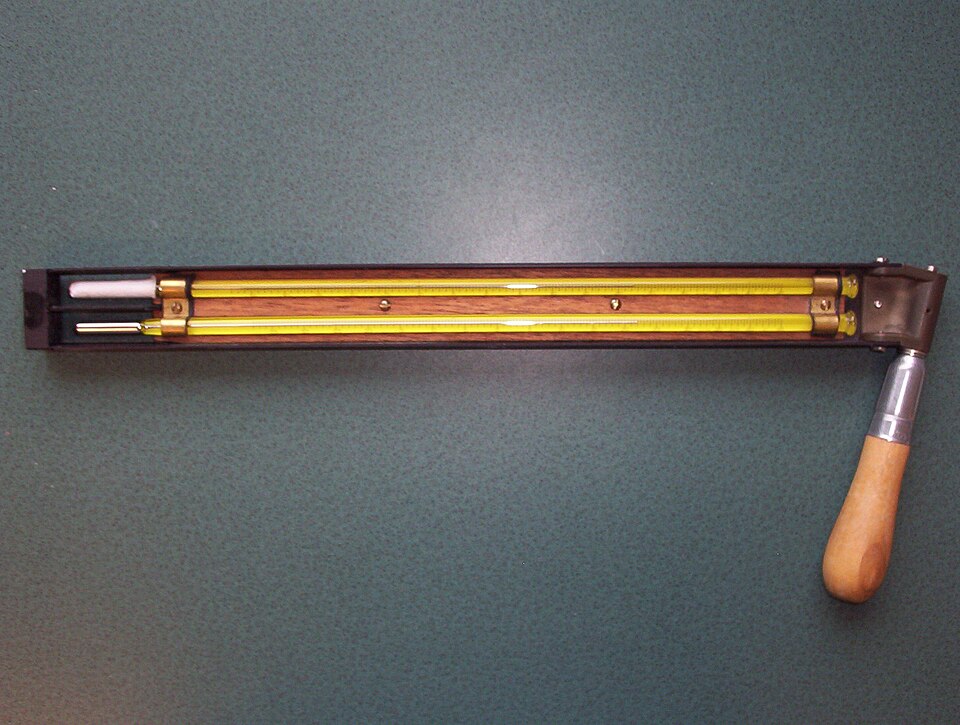
For the wet-bulb case, an exact thermodynamic derivation requires a simultaneous heat-and-mass-transfer balance at the wick surface (see the Drying & Humidification topic guide). The psychrometer equation used here, , is the standard engineering linearization of that balance, with the empirical constant Ap ≈ 6.66×10⁻⁴ °C⁻¹ absorbing the heat/mass transfer coefficients for a normally ventilated wet-bulb thermometer.
The Psychrometric Chart
The saturation curve and constant-RH curves below are computed live from the same humidity-ratio relationship derived above, at standard atmospheric pressure, so the amber-marked points line up exactly with the two worked examples further down this page.
When You'll Need It in GATE Chemical Engineering
- Humidification & drying problems, computing the humidity of air before and after a humidifier, or the driving force for constant-rate drying, both start from this calculator's relationships.
- Wet-bulb / dew point conversions, problems that give one temperature and ask for another (or for relative humidity) are a direct application of the psychrometer equation here.
- Cooling tower & air-conditioning numericals, less common on GATE CH specifically, but the same humidity-ratio relationships underlie these calculations when they appear.
- Mass Transfer topic guide, see the Drying & Humidification section of the Mass Transfer topic guide for the drying-rate-curve application of these properties.
Two Fully Worked Examples
Example 1: Humidity Ratio from Relative Humidity
Problem: Air at 30°C has a relative humidity of 50%. Find the humidity ratio.
Answer: H ≈ 0.01331 kg water/kg dry air
Example 2: Relative Humidity from Wet-Bulb Temperature
Problem: Dry-bulb temperature is 28°C and wet-bulb temperature is 20°C. Find the relative humidity.
Answer: RH ≈ 47.5%
Common Mistakes GATE Students Make
- Confusing wet-bulb temperature with dew point. Wet-bulb is an evaporative-cooling equilibrium; dew point is where condensation would just begin, they coincide only at saturation (RH = 100%).
- Using the wrong molecular weight ratio. The 18/29 factor (water/air molecular weight ratio) is easy to invert by mistake, double-check which quantity is in the numerator.
- Ignoring the Antoine equation's valid temperature range. Results outside roughly 1–100°C use extrapolated vapor pressures that no longer reflect real water behavior.
- Assuming humidity ratio and relative humidity scale the same way. RH depends on both actual and saturation vapor pressure (which itself depends on temperature); humidity ratio does not directly involve saturation pressure at all, the same H can correspond to very different RH values at different temperatures.
Key Takeaways
- Every psychrometric property traces back to the water vapor partial pressure, via the Antoine equation.
- Humidity ratio H = (18/29)·pw/(P−pw); relative humidity RH = pw/pws × 100.
- The psychrometer equation converts wet-bulb readings to vapor pressure using an empirical constant Ap ≈ 6.66×10⁻⁴ °C⁻¹.
- All relationships here assume standard atmospheric pressure (760 mmHg).
- Valid only over the water Antoine equation's fitted range, roughly 1–100°C.
Frequently Asked Questions
Anywhere a process cares about the water vapor riding along with air rather than the air itself, sizing a dryer's driving force, checking a cooling tower's approach, or converting a wet-bulb field reading into something usable in a mass balance. See the derivation below for how every one of these properties reduces to a single underlying vapor-pressure relationship.
Keep Exploring
Related
Drying & Humidification
Psychrometry, wet-bulb temperature, and constant-/falling-rate drying curves for GATE CH.
Open →Antoine Equation
Calculate P* = 10^(A − B/(C+T)) for Benzene and Water. Includes GATE 2025 Q47 dew point solution.
Open →GATE CH Formula Sheet
Every core GATE Chemical Engineering formula in one place, grouped by topic with variable definitions.
Open →GATE Practice Tests by Year
Full-length, timed GATE CH practice tests (2024–2026) with instant, step-by-step-explained results.
Open →