August 1, 2026
The Basic Idea: Boil, Rise, Cool, Repeat
Distillation works because different liquids boil at different temperatures. Heat a mixture of ethanol and water and the vapor coming off is richer in ethanol than the liquid underneath it, simply because ethanol is the more volatile of the two and evaporates more readily. Condense that vapor and you've got something noticeably more concentrated in ethanol than you started with. That's really the whole idea. A distillation column just repeats that one step, boil, rise, condense, over and over, because a single pass almost never gets you close enough to pure.
It doesn't do this by literally re-boiling the same batch again and again. A column is a tall vessel, hot at the bottom, cooler near the top, with vapor rising through liquid that's falling. Where they meet, some vapor condenses and gives up heat, which boils off a bit of the liquid in turn. The vapor that leaves each of these contacts is a little richer in the light component than what went in; the liquid left behind is a little poorer. Stack enough of these contacts and the vapor at the top gets driven close to pure light component, while the liquid at the bottom ends up close to pure heavy component.
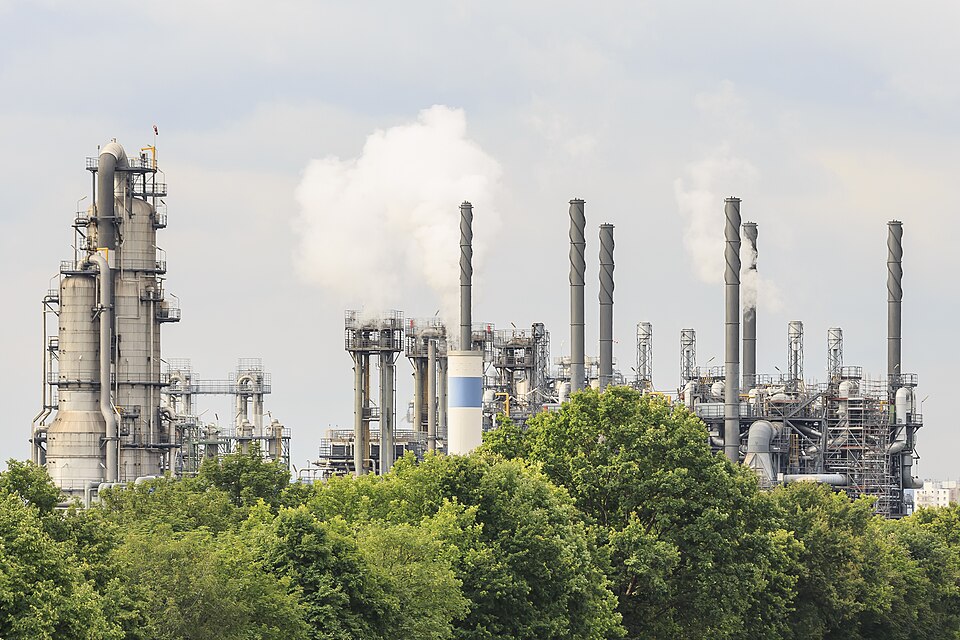
Trays: Where the Contact Actually Happens
Most real columns do this with trays: horizontal plates stacked inside the vessel, each punched with small holes or fitted with bubble caps that let vapor push up through a shallow pool of liquid sitting on top. Vapor bubbles through, mass and heat get exchanged, and what comes out above the tray is richer than what went in below it. The liquid, meanwhile, spills over a weir and drops to the tray below through a downcomer. So liquid works its way down the column one tray at a time while vapor works its way up.
Chemists and engineers call one idealized tray, one that reaches full equilibrium between the liquid and vapor leaving it, a theoretical stage. No real tray is perfectly efficient, so a column always needs more actual trays than the theoretical-stage count suggests. That ratio is the tray efficiency, usually somewhere around 60-90% for a well-designed tray. Packed columns skip trays altogether and use loose or structured packing instead, getting the same repeated contact continuously along the packing height rather than in discrete steps, often at lower pressure drop, which is why they show up so often in vacuum distillation.
Reflux: Why You Throw Product Back In
This is the part that trips people up the first time they see it. The condensed vapor at the very top of the column, the purest stream in the whole system, doesn't all get taken off as product. Some of it gets pumped straight back down as reflux. It looks wasteful until you notice what it's actually for: reflux is what gives the column a falling liquid stream to begin with. Without it, there's no liquid above the feed point at all, and no repeated contact. You'd just have a single evaporation, not a column.
The reflux ratio, how much liquid goes back down versus how much product actually leaves, is one of the two or three variables that define a column's operation. Push it higher and separation improves for the same number of trays, but you're also boiling and condensing more for the same net product, which costs energy. There's a minimum reflux ratio below which no number of trays gets you the separation you need, and a minimum number of trays that only works at total reflux, where nothing leaves as product at all. Real columns sit somewhere in between, typically around 1.1 to 1.5 times the minimum reflux ratio, close enough to the theoretical minimum to save on energy, far enough from it to keep the column a reasonable size.
Why Some Separations Are Much Harder Than Others
How hard a distillation is comes down mostly to relative volatility, how far apart the two components' vapor pressures actually sit. Hexane and decane boil at very different temperatures, so separating them might take a handful of trays. Two close-boiling isomers, or a pair that forms an azeotrope, where liquid and vapor end up with identical composition and no amount of further boiling separates them any further, can need dozens of trays, very high reflux, or a different technique entirely, like extractive distillation, which adds a third component just to break the azeotrope apart.
That number gets calculated early in almost every real distillation problem for a reason: it tells you, before you design a single tray, roughly how hard the job is and whether ordinary distillation is even the right tool.