GATE 2025 Chemical Engineering, Q48 · Thermodynamics
The correct answer is 595 to 605.
Question
An ideal monoatomic gas is contained inside a cylinder-piston assembly connected to a Hookean spring, as shown in the figure. The piston is frictionless and massless, with cross-sectional area and a stopper 5 cm away. Ambient pressure is 1 bar. Initial gas conditions: L, K. The spring constant is 10 kN/m and is initially unstretched. The gas is expanded reversibly by adding 362.5 J of heat, until the piston presses against the stoppers at the final equilibrium state. Neglecting heat loss to the surroundings, the final equilibrium temperature of the gas is ____ K (rounded off to the nearest integer). Given: for a monoatomic ideal gas, (3/2)R, where R = 8.314 J/(mol·K).
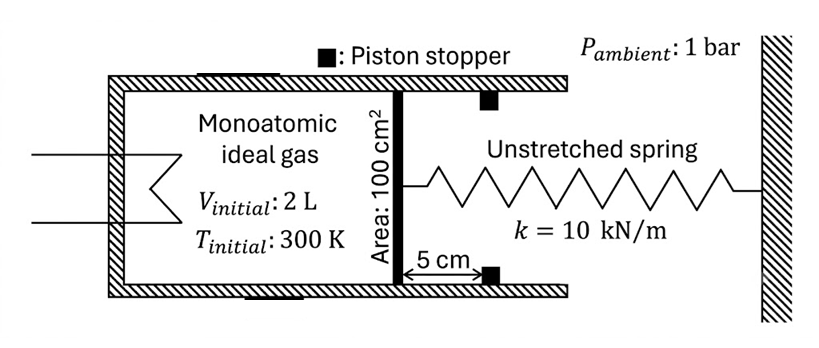
Official answer: 595 to 605
Why
GATE 2025 official key: 595 to 605 K. m Force balance gives P(x) kx/A, so work done by gas W J. Energy balance: Q − W = 362.5 − 62.5 = 300 J. Since n and nR J/K, K, so K.
Explanation cross-checked for consistency. Final answer matches the official IIT answer key.