August 8, 2026
The Problem: Liquid Boiling Inside a Pump
Cavitation happens when the pressure inside a pump drops below the liquid's own vapor pressure and the liquid boils, not from heat, but from pressure loss. It happens most readily right at the eye of the impeller, where the fluid accelerates and pressure drops as a direct side effect of the pump doing its job, the same reason pressure drops over a curved airplane wing as air speeds up across it.
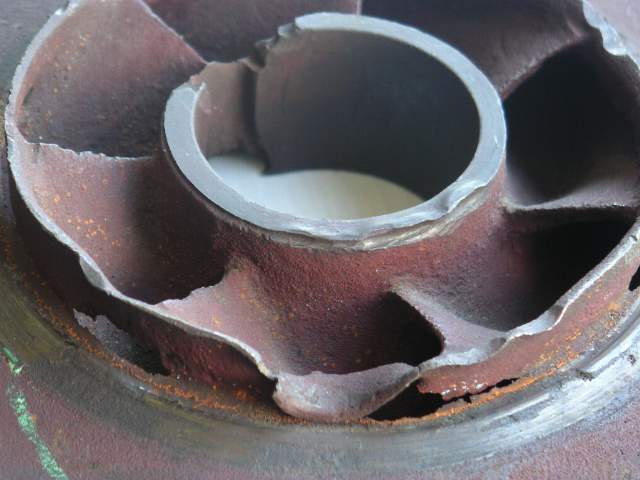
The bubbles that form there get carried along into a higher-pressure region further into the impeller, where they collapse almost instantly, on the order of microseconds. Each collapse throws off a tiny shockwave and a needle-thin, extremely fast liquid jet aimed straight at whatever surface happens to be nearby, usually the impeller vane. One collapse does nothing at all. Millions of them, repeating continuously while the pump cavitates, wear metal away one microscopic hit at a time. That's the pitted, almost sponge-like surface you see on an impeller that's cavitated for even a few hundred hours.
NPSH Available: What the System Gives the Pump
Net Positive Suction Head Available, NPSHa, is the pressure margin sitting at the pump suction above the liquid's vapor pressure, expressed as an equivalent height of liquid, after every loss between the source and the pump inlet has been subtracted out. You calculate it from the physical layout: the pressure at the source, the elevation difference between the liquid surface and the pump (helpful if the source sits above the pump, a penalty if it sits below), the friction losses in the suction line, and the vapor pressure of the liquid itself, which is a real loss, the hotter the liquid, the higher its vapor pressure, and the more it eats into NPSHa.
None of this depends on which pump you buy. It's entirely a property of the tank, the piping, and the fluid. Swap in a completely different pump model and NPSHa doesn't change at all.
NPSH Required: What the Pump Demands
NPSH Required is the other half of the equation, and this one belongs to the pump, not the system. It's the minimum margin that specific pump design needs at its suction so the pressure drop at the impeller eye never reaches the liquid's vapor pressure. Manufacturers measure it on a test stand and publish it as a curve against flow rate, and it climbs as flow rate climbs, because pushing more fluid through the same impeller makes the pressure drop at the eye worse.
The rule is simple enough to say in one line: NPSHa has to exceed NPSHr, usually with some margin on top, commonly half a meter to a meter depending on how conservative the design needs to be. Both numbers carry real uncertainty, so running right at the boundary invites intermittent cavitation whenever conditions drift even slightly.
Why This Catches People Off Guard
What surprises most people learning this for the first time is that cavitation is entirely a suction-side problem. A pump can be dead-headed against enormous discharge pressure and run fine; the same pump starved on suction, pulling from a nearly empty tank through a suction line that's too long or too narrow, cavitates almost immediately. It also gets worse as the liquid heats up, not better, because vapor pressure climbs sharply with temperature. A pump running happily on cold water can start cavitating on that same water once it warms up, purely because the vapor-pressure term in NPSHa shrank underneath it.
That's why NPSH margin is one of the first things anyone checks when specifying a pump for something hot or volatile, and why the standard fixes, raise the pump, shorten the suction line, cut suction-side friction losses, never touch the pump itself. The pump was never the problem. The margin it was given to work with was.