October 23, 2026
A Race Between Reaction and Diffusion
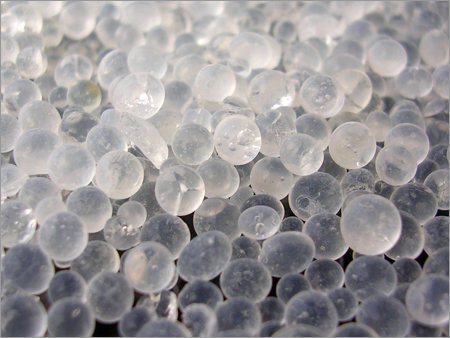
Most industrial solid catalysts are porous pellets, with the active sites spread over an enormous internal surface area inside the pores. To reach those sites, reactant has to diffuse in from the outer surface, and it is being consumed as it goes. If diffusion is fast compared with reaction, the concentration stays nearly uniform throughout the pellet and every active site works at full rate. If reaction is fast, the reactant is used up near the outside, and the pellet's interior sits idle.
In 1939 Ernest Thiele, the same Thiele as the McCabe-Thiele method, wrote this race as a single dimensionless number. For a first-order reaction in a slab-shaped pellet, the Thiele modulus is φ = L·√(k/D_e), where L is the half-thickness, k the rate constant, and D_e the effective diffusivity in the pores. Its square is the ratio of the intrinsic reaction rate to the diffusion rate.
The Effectiveness Factor
The effectiveness factor η is the actual rate of the whole pellet divided by the rate it would have if the entire interior saw the outer-surface concentration. For a first-order reaction in a slab, solving the diffusion-reaction equation gives η = tanh(φ)/φ. For a sphere of radius R, with φ = R·√(k/D_e), it becomes η = (3/φ²)(φ·coth φ − 1).
The two limits are simple. For small φ, below about 0.3, η is very close to 1: the catalyst is fully used. For large φ, η falls toward 1/φ for a slab or 3/φ for a sphere, meaning only a thin outer shell of the pellet does any work. Rutherford Aris showed in 1957 that if φ is defined using the pellet's volume-to-surface ratio as the length scale, the curves for slabs, cylinders, and spheres nearly coincide, so a single chart covers most practical shapes.
Diagnosing Diffusion Limits From Real Data
The difficulty is that φ needs the intrinsic rate constant, and that is usually the thing being measured. Weisz and Prater's 1954 criterion avoids the problem by using the observed rate instead: C_WP = (−r'_obs·ρ_c·R²)/(D_e·C_s). If C_WP is much less than 1, internal diffusion is not limiting; if it is much greater than 1, it is severely limiting. A simple experimental check also works: crush the catalyst to a smaller size and remeasure. If the rate per unit mass rises, the original pellets were diffusion-limited.
Strong diffusion limitation also distorts kinetics in a recognisable way. In that regime the observed activation energy falls to about half the true value, and the apparent reaction order shifts from n to (n + 1)/2. A kinetic study that misses this ends up reporting rate parameters that describe diffusion as much as chemistry, and those parameters fail when the pellet size changes.
What Designers Do About It
The obvious remedy is smaller pellets, since η depends on size through φ. But in a packed bed, smaller particles raise pressure drop sharply, so pellet size is a trade-off between catalyst utilisation and pumping or compression cost. Shaped pellets such as rings, trilobes, and extrudates with small cross-sections offer short diffusion paths while keeping the bed open enough for flow.
Another approach is to put the active material only where it will be used. In an egg-shell catalyst, the expensive metal is deposited in a thin layer near the outer surface of the support, since for a fast reaction the interior would contribute little anyway. That saves precious metal and, for some reaction networks, also improves selectivity by limiting how long intermediate products spend inside the pores.
References
- Thiele, E. W. (1939). Relation between catalytic activity and size of particle. Industrial & Engineering Chemistry, 31(7), 916–920. doi:10.1021/ie50355a027
- Aris, R. (1957). On shape factors for irregular particles—I: The steady state problem. Diffusion and reaction. Chemical Engineering Science, 6(6), 262–268. doi:10.1016/0009-2509(57)85028-3
- Weisz, P. B., & Prater, C. D. (1954). Interpretation of measurements in experimental catalysis. Advances in Catalysis, 6, 143–196. doi:10.1016/S0360-0564(08)60390-9
- Fogler, H. S. (2016). Elements of Chemical Reaction Engineering (5th ed.), Chapter 15. Boston: Prentice Hall.
- Froment, G. F., Bischoff, K. B., & De Wilde, J. (2011). Chemical Reactor Analysis and Design (3rd ed.). Hoboken, NJ: Wiley.