August 22, 2026
One Ratio, Two Completely Different Flow Regimes
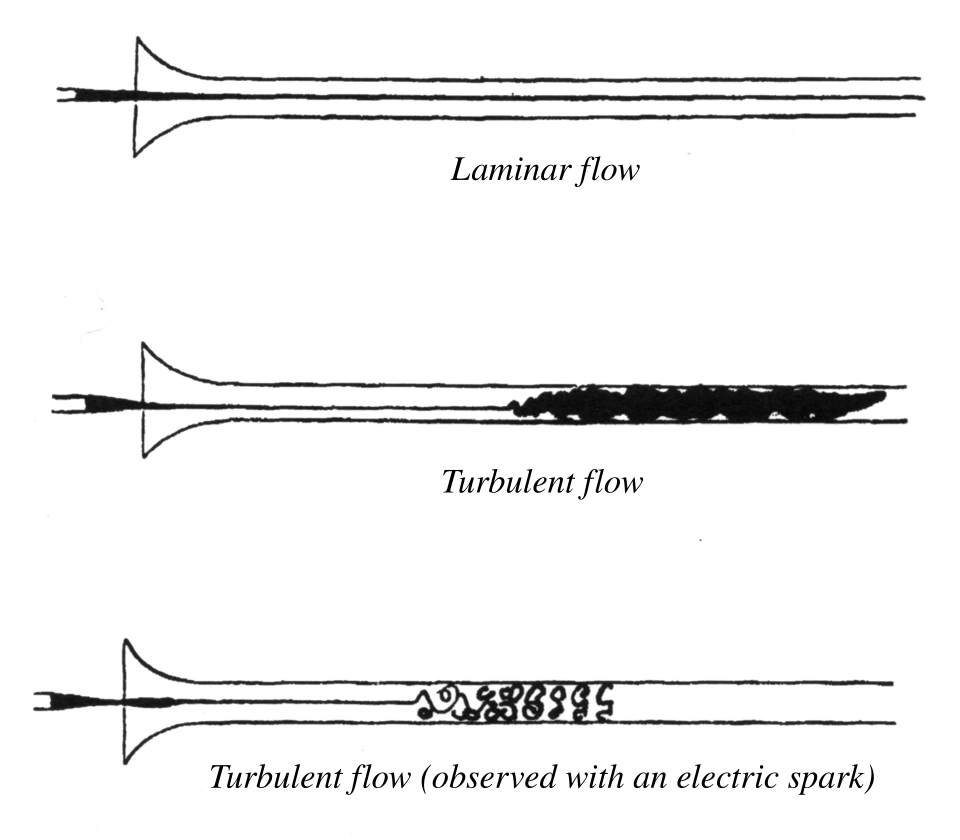
Reynolds number, Re = ρvD/μ, is the ratio of inertial forces to viscous forces in a moving fluid. That sounds abstract until you see what it does: at low Re, viscous forces win, damping out any disturbance before it can grow, so the fluid slides along in smooth parallel layers, laminar flow. At high Re, inertia wins instead, small disturbances grow rather than die out, and the flow breaks into the chaotic, mixing motion we call turbulent. The pipe hasn't changed. The fluid hasn't changed. But the flow pattern, and everything that depends on it, changes completely.
For flow in a round pipe, the usual dividing lines are Re below about 2100 for laminar and above about 4000 for fully turbulent, with the range in between called transitional. It's genuinely unstable there, prone to flickering between the two regimes even at a constant flow rate, which is exactly why careful pipeline design avoids sitting in that range on purpose.
Why the Distinction Matters So Much
Nowhere does this show up more clearly than in pressure drop. In laminar flow, the friction factor is exactly f = 64/Re, a clean result you can derive straight from a force balance on a fluid element, because laminar flow is smooth enough to be mathematically tractable. Turbulent flow has no equivalent closed-form answer. Instead, engineers reach for semi-empirical correlations like the Colebrook equation, built from decades of pipe-flow testing, because the chaotic mixing of turbulence has resisted an exact analytical solution for well over a century of serious effort.
Turbulence also mixes far better than laminar flow does, which cuts both ways: it's a real advantage for heat transfer or blending an additive into a stream, and a real cost in the higher pressure drop and pumping power it demands. Most industrial piping still runs turbulent anyway, and not despite that extra cost. A pipe wide enough to keep flow laminar at the same flow rate usually costs more upfront than the extra pumping power costs over the plant's whole operating life.
What Actually Changes Reynolds Number in Practice
Four things move Re: density, velocity, pipe diameter, and viscosity. In a running plant, velocity is the one engineers actively push around, throttle a valve or shift a pump's operating point and flow rate, and with it velocity, changes directly. Viscosity is the one that surprises people, because it can swing enormously with temperature. A viscous oil that's sluggish and laminar when cold can turn fully turbulent once heated, sometimes with nobody touching the flow rate at all. A pipeline sized and characterized at one operating temperature can quietly land in a completely different flow regime at another, and that gotcha shows up more often than you'd expect.
It's also why Reynolds number is nearly always the first thing computed in a fluid mechanics or heat transfer problem. Which friction factor correlation applies, which heat transfer correlation applies, even how the pump curve is expected to behave, all of it branches on whether the flow is laminar or turbulent. Get that one classification wrong and everything downstream that assumed the other regime is wrong along with it.