August 29, 2026
The Waste a Single Evaporator Leaves on the Table
A single evaporator is simple enough: steam condenses inside a heating element and gives up its latent heat to boil water out of a feed solution on the other side. In round numbers, one kilogram of steam boils off about one kilogram of water, a steam economy of roughly 1. The catch is that the vapor leaving the process side still carries almost all of that latent heat with it. It's every bit as hot, and every bit as capable of giving up heat, as the steam that made it. In a single-effect evaporator, that vapor just gets condensed and thrown away, or sent off to cooling water. All that latent heat leaves the process having done nothing.
That adds up to real money at industrial scale, and a lot of industrial evaporation runs at exactly that scale: concentrating fruit juice, black liquor in pulp and paper mills, seawater in a desalination plant, sugar solutions, dozens of other aqueous streams that need concentrating before the next step. Throwing away that much latent heat, cycle after cycle, gets expensive fast.
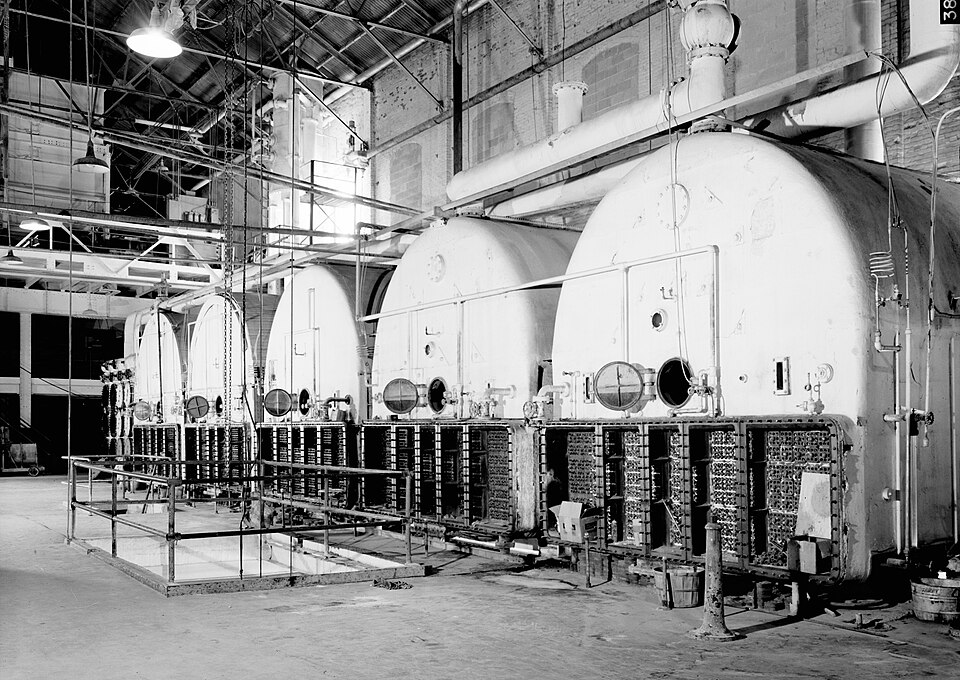
The Trick: Chain Several Effects So the Vapor Gets Reused
Multiple-effect evaporation fixes this by running several evaporator bodies, called effects, in series, each one at a lower pressure than the last, and so a lower boiling temperature. Only the first effect ever sees live steam from the boiler. The vapor it boils off, still hot, becomes the heating medium for the second effect, which runs at a low enough pressure that this hand-me-down vapor is still hot enough to boil its feed. The second effect's vapor heats the third, and so on down the line.
That same original kilogram of live steam ends up doing duty N times across an N-effect train, a kilogram of water boiled in the first effect, roughly another kilogram in the second, and so on. Steam economy, the total water evaporated across the whole train per kilogram of live steam actually fed in, climbs toward N for a well-designed train instead of sitting near 1. A good triple-effect train gets close to three times the evaporation a single effect would manage on the same steam.
Why Not Just Add More and More Effects?
If more effects mean better economy, why not run ten or twenty? The limit is the available temperature span. Every effect needs its heating steam meaningfully hotter than the solution it's boiling, or heat transfer slows to a crawl, and the total temperature range from live-steam temperature down to whatever the final condenser can accept is fixed. That fixed range has to be divided across every effect in the train. Add more effects and each one gets a smaller slice, which means less driving force, which means more heat transfer area needed to move the same heat.
Real designs settle somewhere around two to six effects, occasionally more for something as energy-intensive as seawater desalination, balancing the steam saved against the capital cost of another vessel and more heat transfer area. Past that point, the next effect costs more in equipment than it saves in steam, and the sensible move is to stop adding effects and look at something like vapor recompression instead.
Boiling Point Elevation: The Complication That Eats Into the Savings
There's one wrinkle that keeps real trains from hitting their theoretical N-to-1 economy exactly. A solution boils hotter than pure solvent at the same pressure, an effect that gets more pronounced as the solution concentrates further down the train. That extra boiling temperature eats directly into the already-tight driving force each effect has to work with, which is a big part of why real economy always lands a bit below the ideal N. It's usually estimated with Dühring's rule, a correlation that plots a solution's boiling point linearly against the pure solvent's boiling point at a given concentration, simple enough to use by hand, and accurate enough to have stayed the standard method for this in evaporator design.