September 5, 2026
The Same Problem, Approached Two Ways
Heat exchanger sizing all comes down to one equation: Q = U·A·ΔT, heat duty equals overall heat transfer coefficient times area times some representative temperature difference. Every method for sizing an exchanger is really just a different way of handling that ΔT term, because both streams change temperature as they pass through, so there's no single obvious ΔT to use. LMTD and effectiveness-NTU are the two standard ways engineers handle it, and they're solving the same physical problem from opposite ends, they just start from different known quantities.
LMTD: Straightforward When You Know All Four Temperatures
The Log Mean Temperature Difference method computes ΔTlm = (ΔT₁ − ΔT₂)/ln(ΔT₁/ΔT₂), where ΔT₁ and ΔT₂ are the temperature gaps between hot and cold streams at each end of the exchanger. It's a logarithmic average rather than an arithmetic one because the gap between the two streams doesn't shrink linearly along the exchanger, it decays roughly exponentially for constant heat capacities, and the log mean is the exact average for that shape, not an approximation of it.
LMTD is the direct route whenever you already know all four terminal temperatures, both fluids' inlets and outlets. ΔTlm falls straight out of a calculation, and Q = U·A·ΔTlm hands you whichever of Q, U, or A you're still missing. That's exactly the shape of a rating problem: you've got a specific exchanger and known inlet and outlet conditions, and you just want to know if it's big enough. All four temperatures are usually specified up front, so LMTD applies cleanly.
NTU-Effectiveness: For When You Don't Know an Outlet Temperature Yet
LMTD runs into trouble on a different, very common kind of problem: you know the inlet temperatures and the exchanger's UA, but not the outlets, because the outlets are the thing you're actually trying to find. LMTD needs those outlet temperatures just to compute ΔTlm in the first place, which makes it circular, you'd need the answer to get the answer. Historically that meant guessing an outlet temperature, checking it, and iterating, which works but gets tedious fast by hand.
Effectiveness-NTU sidesteps the whole problem by reframing it around effectiveness, the ratio of actual heat transferred to the maximum theoretically possible for that exchanger, and NTU, a dimensionless grouping of UA and the minimum stream heat capacity rate. Correlations or charts tie effectiveness directly to NTU and the heat capacity ratio for a given flow arrangement, with no outlet temperature needed as an input anywhere. Given UA and the inlet conditions, you compute NTU, read off effectiveness, and back out the heat duty and both outlet temperatures in one pass. No iteration.
Which One to Reach for
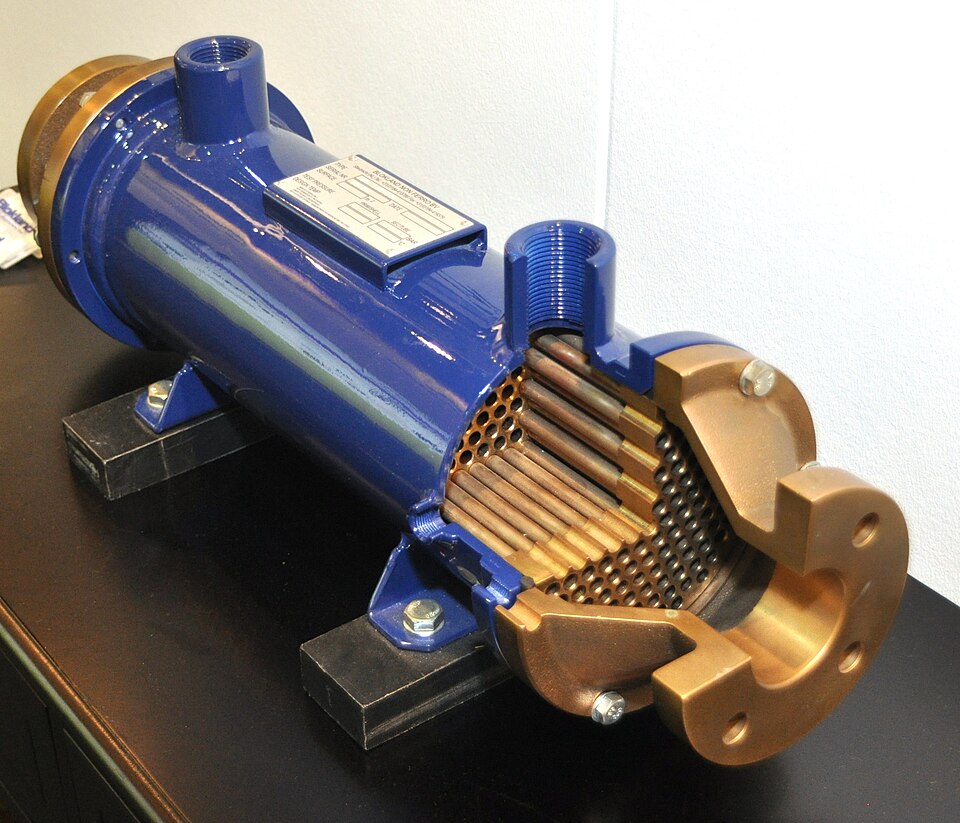
The rule of thumb in practice: LMTD for rating problems, where all four temperatures are known and you're solving for area or U; effectiveness-NTU for design or performance-prediction problems, where you know the inlets and UA but not the outlets. Both are exact under the same idealizations, constant properties, no unmodeled phase-change effects, and, for anything other than pure counter-current or co-current flow, a correction factor for LMTD or a specific effectiveness correlation for NTU to match the actual arrangement, like a multi-pass shell-and-tube exchanger.
Neither one is the better method in general. They're the same physics, rearranged around whichever variables you happen to already know, and a working engineer just picks the one that matches the information sitting in front of them.