September 18, 2026
The No-Slip Condition and the Paradox It Solved
A real fluid in contact with a solid surface does not slide over it. The molecules right at the wall move with the wall, a fact known as the no-slip condition. A short distance away, the fluid moves at nearly the full free-stream velocity. All of the change between those two speeds happens in a thin region next to the surface, and that region is the boundary layer.
Before 1904, fluid dynamics was split awkwardly in two. The mathematics of frictionless fluids was elegant but predicted that a body moving steadily through a fluid feels no drag at all, a result known as d'Alembert's paradox and plainly contradicted by every boat and bridge pier ever built. The full viscous equations were correct but impossible to solve for practical shapes. Ludwig Prandtl's insight, presented in a short paper at a mathematics congress in Heidelberg, was that viscosity only really matters inside that thin layer. Outside it, the frictionless theory works fine. Solve the two regions separately, match them at the edge, and practical problems become tractable.
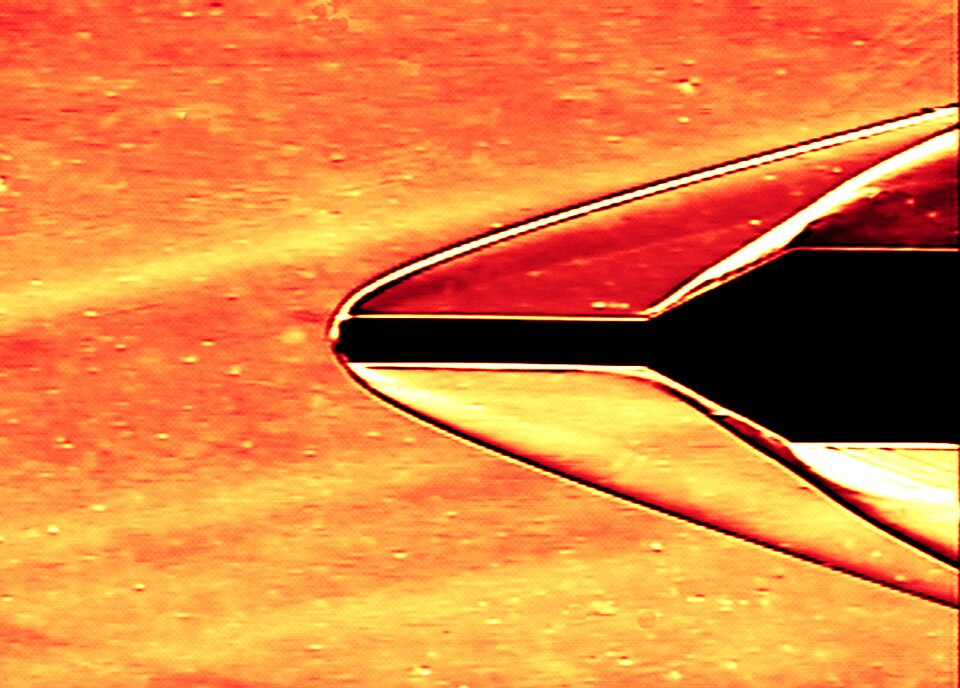
How Thick It Gets, and When It Turns Turbulent
For flow along a flat plate, Prandtl's student Heinrich Blasius solved the laminar boundary layer equations exactly in 1908. The result is that the layer grows with the square root of distance from the leading edge: δ ≈ 5.0x/√Re_x, where Re_x is the Reynolds number based on distance x along the plate. The local skin friction coefficient falls the same way, c_f = 0.664/√Re_x, so the wall shear is highest right at the leading edge where the layer is thinnest.
The laminar layer does not last forever. Somewhere around Re_x ≈ 5 × 10⁵ on a smooth plate it becomes unstable and transitions to turbulence, though the exact point can shift by a factor of several depending on surface roughness and how turbulent the oncoming flow already is. A turbulent boundary layer grows faster, roughly as x to the four-fifths power, and has much higher wall shear, because eddies carry fast-moving fluid right down toward the surface.
Separation: When the Layer Leaves the Wall
Boundary layers behave well when pressure falls in the flow direction and badly when it rises. Flowing into rising pressure, the slow fluid near the wall has too little momentum to keep going, stops, and eventually reverses. At that point the boundary layer lifts off the surface, the flow separates, and a wide, low-pressure wake forms behind the body. Most of the drag on a bluff body like a cylinder or sphere comes from that wake, not from skin friction.
This produces one of the stranger results in fluid mechanics. A turbulent boundary layer, with its better-mixed, higher-momentum fluid near the wall, resists separation longer than a laminar one. So when the boundary layer on a sphere turns turbulent, around a Reynolds number of 3 × 10⁵, the separation point moves rearward, the wake narrows, and the drag coefficient drops sharply. The dimples on a golf ball exist to trigger that transition early.
Why Chemical Engineers Care
Heat and mass transfer between a wall and a flowing fluid have to cross the boundary layer, so its thickness sets the resistance. A thinner layer means a steeper gradient at the wall and faster transfer, which is why heat transfer coefficients rise with velocity. The thermal boundary layer grows alongside the velocity layer, and for laminar flow their thickness ratio scales roughly as Pr^(-1/3). That is the origin of the Pr^(1/3) factor that shows up in so many heat and mass transfer correlations.
The same idea governs pipe entrance lengths. Fluid entering a pipe starts with a thin boundary layer that grows until it fills the pipe, after which the velocity profile stops changing and the flow is called fully developed. For laminar flow that takes roughly 0.05·Re·D of pipe length, which can be hundreds of diameters. Turbulent flow develops much faster, in something like ten to sixty diameters. Correlations that assume fully developed flow give the wrong answer for short tubes, and knowing the boundary layer is how you know when to worry.
References
- Prandtl, L. (1904). Über Flüssigkeitsbewegung bei sehr kleiner Reibung. Verhandlungen des III. Internationalen Mathematiker-Kongresses, Heidelberg, 484–491. English translation: NACA Technical Memorandum 452 (1928).
- Blasius, H. (1908). Grenzschichten in Flüssigkeiten mit kleiner Reibung. Zeitschrift für Mathematik und Physik, 56, 1–37.
- Schlichting, H., & Gersten, K. (2017). Boundary-Layer Theory (9th ed.). Berlin: Springer. doi:10.1007/978-3-662-52919-5
- Bird, R. B., Stewart, W. E., & Lightfoot, E. N. (2002). Transport Phenomena (2nd ed.), Chapter 4. New York: Wiley.